
The “Red Pill” movement built its central metaphor on The Matrix, and Lilly Wachowski, who co-wrote and co-directed the film while she was a closeted trans woman, has explained what that metaphor was always about: transformation and waking up.
Colin Davis put it this way: you can’t even hate on trans people without using their language and their art.
The film was written and directed by the Wachowski sisters, Lana and Lilly, who were both closeted trans women when they made it.
Lilly has talked about how the movie was always rooted in the desire for transformation, coming from a closeted point of view. The corporate world wasn’t ready for more explicit storytelling, so they pulled back ideas like the character Switch originally being a man in the real world and a woman inside the Matrix.
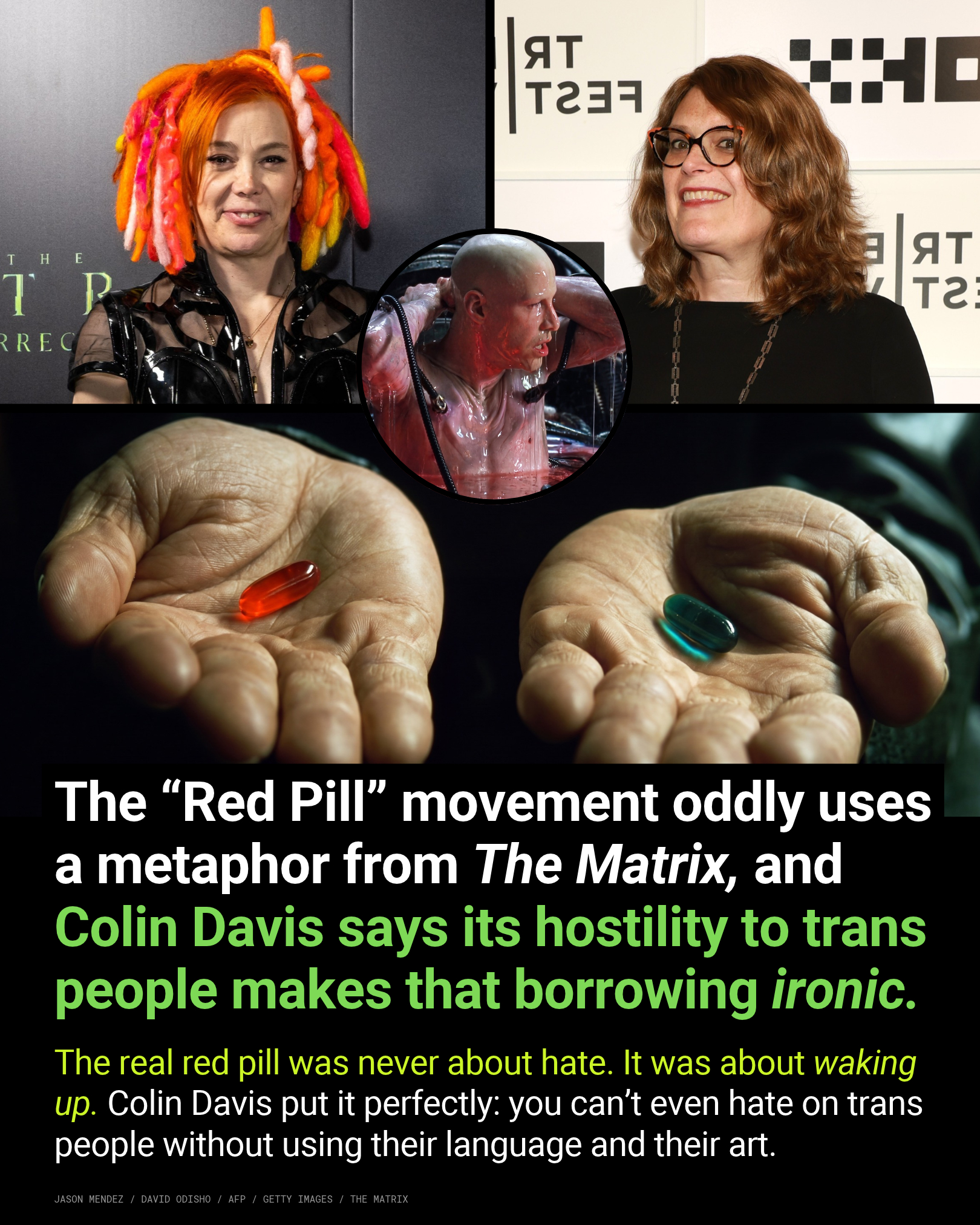
Themes of claiming your true identity (Neo vs. “Mr. Anderson”), rejecting a false oppressive system, and breaking free run through everything. Lilly has clarified that it wasn’t a conscious decision at the time to write a trans allegory, but the transness was simmering underneath it all because that’s who they were.
She loves how meaningful the films have been to trans people who say the movies saved their lives.
When right-wingers, including Elon Musk and Ivanka Trump, tried co-opting the red pill, Lilly’s response was simple: “Fuck both of you.” More recently she’s named the appropriation as right-wing ideology mutating progressive ideas for propaganda and obscuring the real message. “This is what fascism does.”
So what does actually taking the red pill look like today? It’s learning things. It’s choosing empathy over fear and tribalism. It’s rejecting the systems, including capitalism, that keep people trapped in a simulated, extractive version of life. It’s being more progressive about how society can work, for everyone and not just the comfortable and the powerful.
The blue pill is comfortable ignorance and the status quo. The red one is messier, more expansive, and freer.