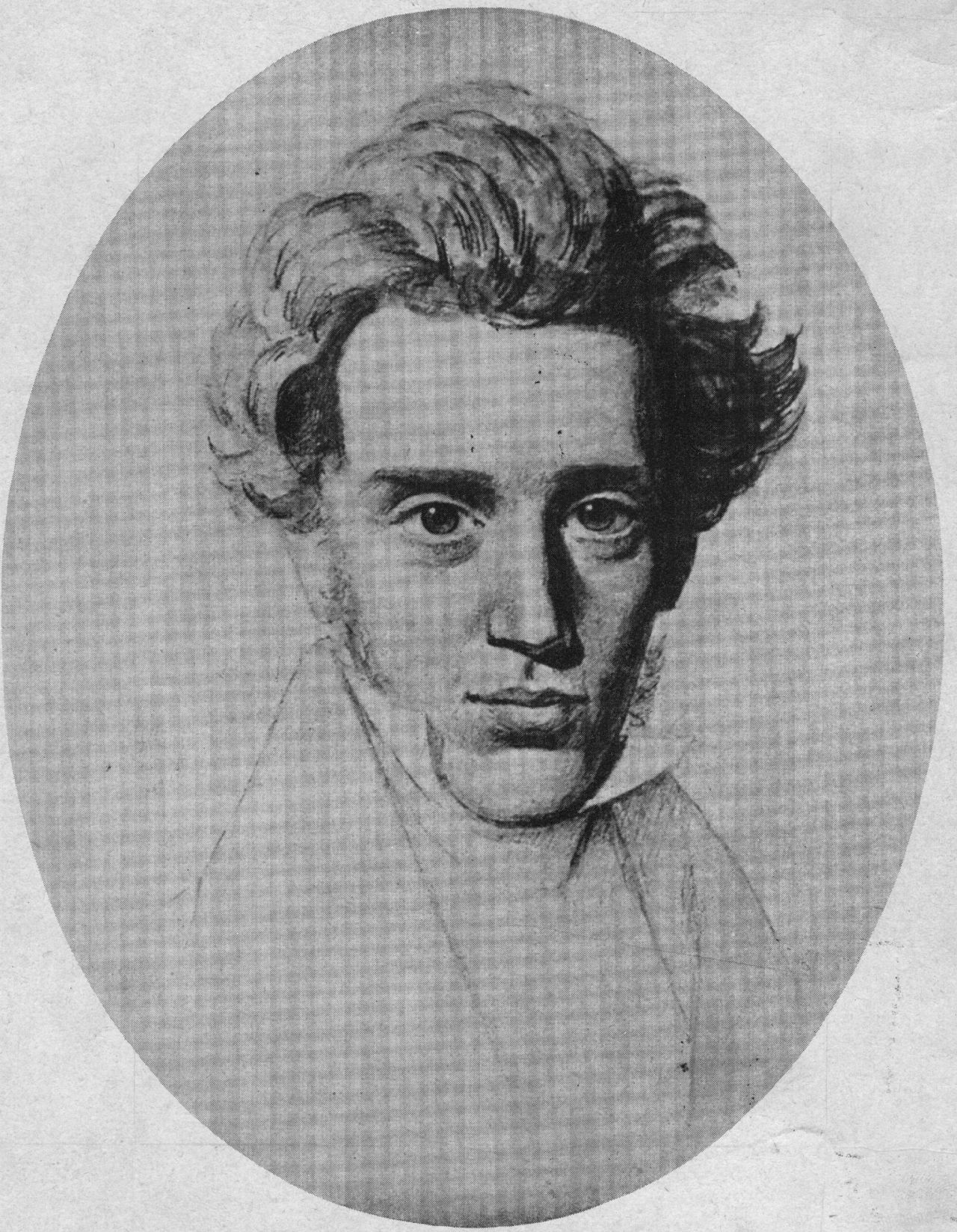
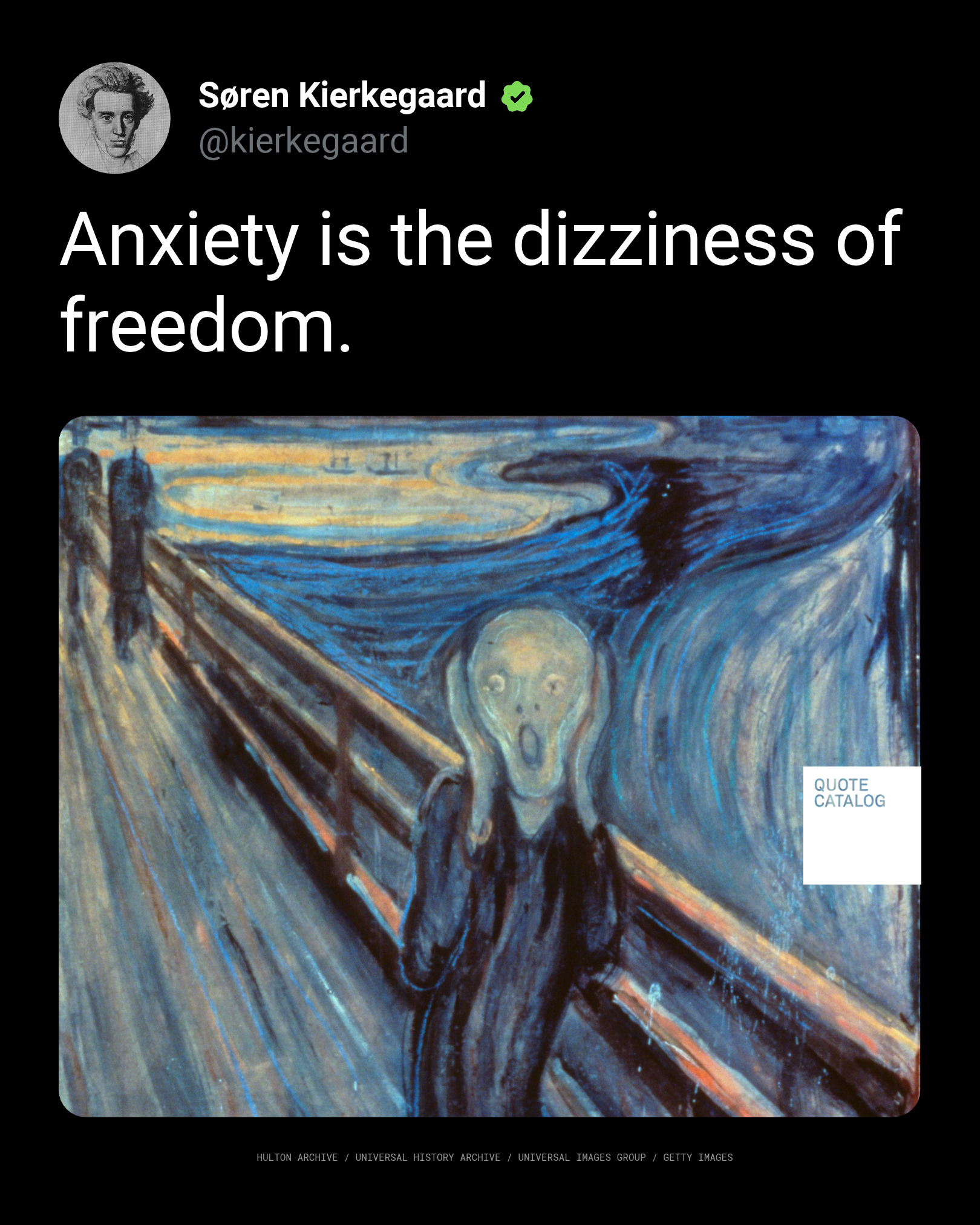
“Anxiety is the dizziness of freedom,” Søren Kierkegaard wrote. In The Concept of Anxiety, published in 1844, the Danish philosopher imagines someone looking into an abyss. The dizziness comes partly from recognizing what they might choose to do.
In Reidar Thomte’s translation, Kierkegaard writes:
“Anxiety may be compared with dizziness. He whose eye happens to look down into the yawning abyss becomes dizzy. But what is the reason for this? It is just as much in his own eye as in the abyss, for suppose he had not looked down. Hence anxiety is the dizziness of freedom, which emerges when the spirit wants to posit the synthesis and freedom looks down into its own possibility, laying hold of finiteness to support itself. Freedom succumbs to dizziness… In that very moment everything is changed, and freedom, when it again rises, sees that it is guilty. Between these two moments lies the leap…”
Fear has a particular threat to face. Kierkegaard’s anxiety concerns what remains possible, including evil, before the leap into guilt. He also believed that learning to be anxious in the right way could, through faith, become a path to salvation.
Born in Copenhagen in 1813, the youngest of 7 children, he grew up in a Lutheran household heavy with his father’s guilt. Michael Pedersen Kierkegaard had risen from a Jutland boyhood of poverty to wealth as a Copenhagen merchant, and believed that cursing God on the heath as a hungry child had doomed the family.
In 1840, he became engaged to 18-year-old Regine Olsen. Convinced he couldn’t make her happy, he broke it off in 1841 and, when she fought the break, played the scoundrel so she would hate him instead of grieve him. Then he fled to Berlin.
Back in Copenhagen, he published The Concept of Anxiety at 31 under the name Vigilius Haufniensis, the Watchman of Copenhagen. He never married, and died in 1855 at 42, collapsing during his campaign against the Danish state church.
For Berkeley philosopher Hubert Dreyfus, known for his work on Heidegger, the risk in Kierkegaard’s writing extends to the commitments that shape an ordinary life. His readings of Fear and Trembling and The Sickness Unto Death emphasize choosing a person, vocation or cause unconditionally, without a conclusive rational guarantee and with the possibility of failure or loss.
Dreyfus understood anxiety as a break in the usual flow of activity: familiar roles and pursuits cease to make the next step seem obvious. He connected Kierkegaard’s religious leap to decisions beyond religion while keeping faith central to Kierkegaard’s own account.
Kierkegaard’s account of anxiety influenced Martin Heidegger’s Being and Time (1927). Jean-Paul Sartre returned to the cliff and its vertigo in Being and Nothingness (1943), describing a man afraid of his own freedom to step into the void.
Dreyfus also argued that the range of possibilities offered by contemporary media can make it harder to stay with a commitment that carries risk. He developed that argument in On the Internet by drawing on Kierkegaard’s The Present Age.